
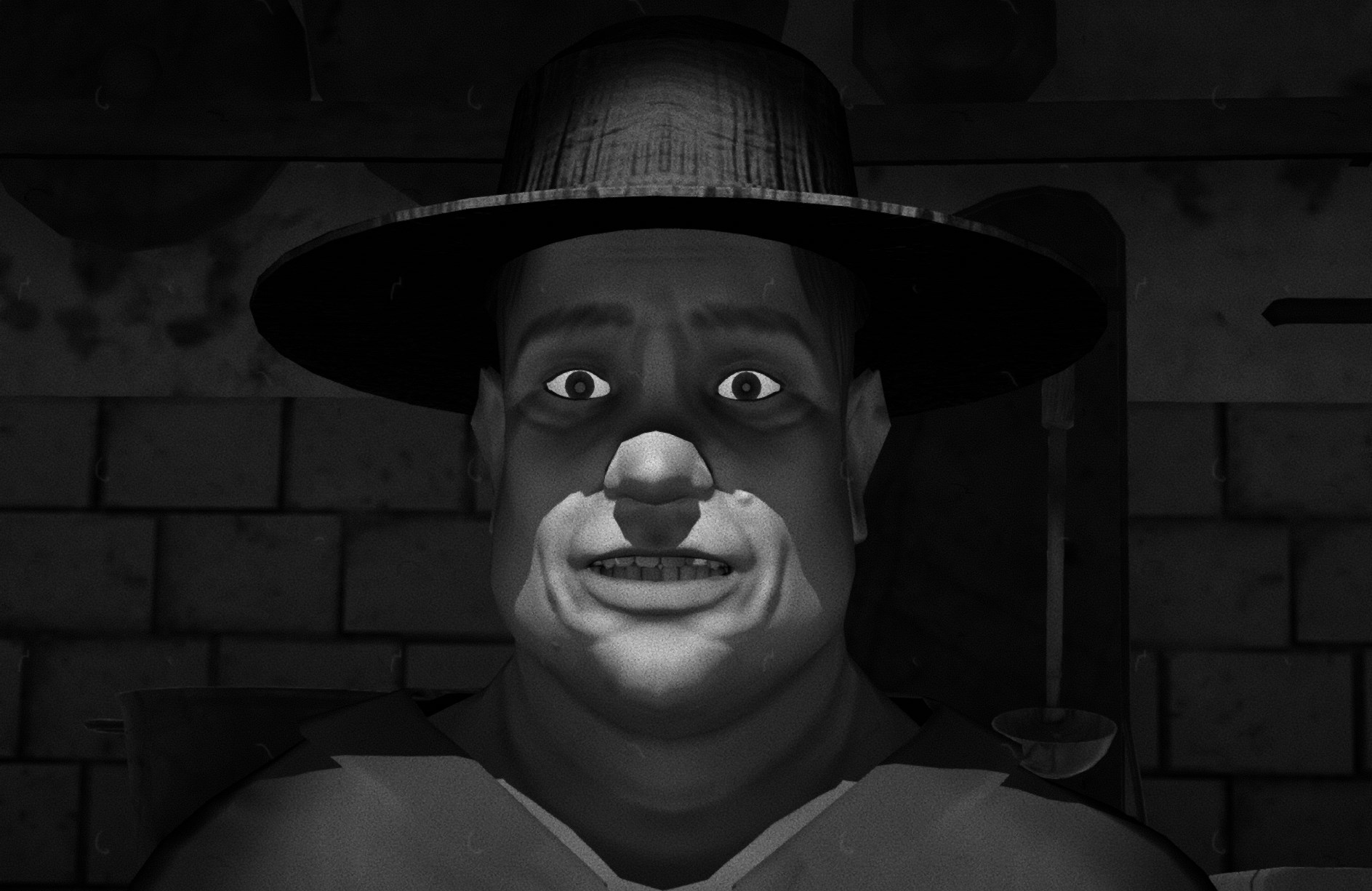
Early in the latest game from acclaimed Italian developer Santa Ragione, you turn the corner and you see them: horses that aren’t horses. They are naked human beings, penned together with equine masks affixed to their heads. They are slaves. As a new farmhand, Anselmo, you see them in stark black and white, and literally so—the game’s presentation resembles a silent film, with grainy visuals accompanied by intertitles for dialogue and limited sound save for the constant whir of an old projector.
But it’s difficult to talk about HORSES without talking about the elephant in the room: the game has been banned from both Steam and the Epic Games Store. It’s a horror story about dehumanization, exploring sexual repression and complicity in the enforcement of puritanical norms. And, under spurious claims of obscenity, it has been functionally cut off from the vast majority of the PC game marketplace.
While the game has been broadly defended in the name of artistic expression, HORSES is often spoken of in abstract terms, like a free-floating object or idea. But art, as we should remember in an age where artificial intelligence continues to devalue human expression, is made by people, and creativity is about decisions that people make under constraints.
I wanted to explore the human processes that went into creating a work like this, that would go on to face such enormous obstacles toward release. For that, HORSES writer/director Andrea Lucco Borlera and Santa Ragione producer Pietro Righi Riva spoke to me about the game’s development over Discord. It was late in Italy. They were tired. The day I spoke with them, the Humble store had seemed to join the Steam and Epic ban, though Humble at least would reinstate HORSES later on.
“After university, I had this idea of making a narrative video game, and trying to have the same artistic approach that certain kinds of directors already had in cinema,” said Borlera. “I’m talking about a certain kind of arthouse cinema that can be pretty intense in what it’s about, that has no fear about certain topics and subjects.” His tone was not one of brash defiance, but something closer to weariness or even embarrassment at all the fuss. Several write-ups for HORSES have expressed a level of disbelief that this is what got everyone so upset, and even with his rather ambitious aspirations, it’s not at all difficult to imagine Borlera himself joining that chorus. “It’s a first game,” he said later, “and one that had a pretty turbulent development. So it’s like a rough diamond. I know it’s rough in the screenplay, in the gameplay, but I don’t know. I think it’s like that for every first work.”

Borlera conceived HORSES as a sort of corrective for what he saw, up to around 2018, as a rather limited range of topics for what games would explore. “Maybe right now the situation is a bit different,” he said. “But at that time, I felt that there was no equivalent of David Lynch in video games, or [Yorgos] Lanthimos, or [Michael] Haneke, or Gaspar Noé. So I said, okay, I would like to try to do something like that. Not to be that sort of auteur myself, but to try and make something in the medium that was more to my own taste.”
HORSES opens with a rather lengthy disclaimer about what difficult subject matter will follow: torture, slavery, sexual assault. But Borlera wasn’t after extremity for its own sake; he respected that these directors made work that was challenging. “When a film is really intense,” he explained, “it’s like a dialogue with the viewer. I feel something.”
Early Development
The game emerged from a one-year IULM Milan master’s course focused on game design, which is now defunct. “It was a more artistic, experimental course about game development and game design, compared to the others offered in Italy that are more traditional and more oriented to make students that are a cog in the mechanism of the industry,” Borlera said. Broken up into modules, the course included among its instructors Pietro Righi Riva, producer and co-founder of Santa Ragione, as well as Auriea Harvey and Michaël Samyn, who both made up indie game studio Tale of Tales. (Another Santa Ragione associate, Mediterranea Inferno developer Lorenzo Redaelli, would attend the course one year after Borlera did.)
“Before the master’s course,” Borlera remembered, “I had a very generic idea, in third person with an aesthetic similar to the game The Path by Tale of Tales.” The course gave him time to think deeply about what would become his thesis project. While he would arrive at a more distinct style during development, he credits one particular aspect of HORSES—the transparent overlay of certain images for emphasis—to inspiration from The Path.
Conceptually, Borlera built on an idea that had stayed with him through the years, an image that would become central to HORSES. He envisioned people in masks, naked and dirty and acting like animals, “led by impulse and natural, primal instinct.” Once the course ended, he continued working on this version of the game and polishing it, sending it off to game festivals—it was selected for Indiecade and A MAZE. This version depicted what is the prologue of the final game, where Anselmo enters the farm and is introduced to the horse-masked slaves.
“Andrea was lucky enough to make his game chronologically,” laughed producer Pietro Righi Riva. Although Riva was one of the course’s instructors, it wasn’t until he met Borlera again, at the Game Happens festival in late 2019, when they discussed collaborating on the project.
Borlera set about developing the story into a complete first draft, while Santa Ragione came aboard the project and began to polish and rework what was there. “I’m not a programmer, so it was a bit clunky,” Borlera said of the original prototype. Riva, though, maintained that the festival version wasn’t so different: “We reworked some of the character models, some of the animations, the UI, how we deliver text onscreen. But I would say that the visual feeling of that first demo is quite similar.”
Three Chapters
Initially, HORSES was conceived as three chapters, with the farmhouse sequence that makes up the entirety of the final game encompassing one chapter. (The A MAZE page notes this early intention.) The silent film aesthetics were, Andrea told me later via email, “meant to evoke the first half the twentieth century. The second part was set in the 1960s-70s and would have been in color, with a more libertarian atmosphere. The third part was closer to a modern era, with cold, industrial tones. In this last section, impulses such as sexuality, rather than being repressed, are almost imposed as a new form of subjugation of the individual.”

What’s striking about HORSES, though, is how fully realized its silent-era style is, how intentional. Beyond just the old-timey feeling that it provided, Borlera was after a sense of grime and grit, inspired by his grandparents’ farmhouse in northern Italy. “That’s why I put the grain, the black and white,” he said. “You cannot convey smells, but I’d like to convey visually that kind of mud and dirtiness.” The use of silence, too, builds a unique sort of atmosphere, with sparing music and sound effects. He likens the hum of the film project to a “brain fog.” He also saw an opportunity to set up and then subvert the player’s expectations: “Sometimes I could break the rule of being silent and put some sound in an expressive way, like the sound of eating.”
Of course, as with any game, some of this was born of necessity. A more sparing use of sound meant, he hoped, less effort for what was already a considerable undertaking for a single developer. Navigating in first-person, too, would hopefully be easier to portray than in third-person (though unlike many lo-fi first-person games, HORSES does show you what Anselmo looks like). In addition, Borlera drew from his own feelings and events in his past, as well as cinematic influences. He mentions The Tree of Wooden Clogs, Ermanno Olmi’s epic Italian drama about peasant life in the late 19th century, as well as strange, deadpan short films like Roy Andersson’s bleakly comic World of Glory (which opens with a group of nude people being gassed in the back of a truck) and Jan Švankmajer’s live-action, black-and-white The Garden (which, in addition to many tight close-ups, features a “living fence” of clothed people holding hands).
As a child, he was fascinated with the animated 1954 adaptation of Animal Farm. “When I was at school, I had stupid ideas,” he laughed, “like a pulpy version of Animal Farm. Like Animal Farm made by Quentin Tarantino, with people in animal masks, and then maybe they kill the owner by accident and start to argue and escape the farm.”
For the game, though, it was always horses. “Even the early ideas for the game, I always had in mind the horse mask, because a horse is a symbol of impulsiveness and something that is difficult to control. So it’s strong, really, the power of instinct.” He remembered, sheepishly, lessons for horseback riding during a summer camp: “I wasn’t a huge fan of equitation because I feel a bit uncomfortable staying on the top of this big, very big, animal that…well, sometimes they get mad.”
The “Famous” Scene
What Borlera wryly termed the game’s most “famous” scene also came from past experience. “It was a two-day summer job when I was 15,” he wrote in an email. “There were teenagers accompanied by their parents, and I had to give them a ride on the pony. I was a bit clumsy: I had to keep the animal under control, as it occasionally acted up, and maintain some kind of conversation with the person I was taking around the enclosure. This memory came back to me when I was thinking about the various situations in which horses are usually used, in order to reinterpret them in the game in their grotesque version with humans.”
As depicted in the game, one day there are visitors to the farm, a wealthy father and his daughter. You lead the daughter around on a slave, awkwardly making conversation. “When we sent the game to Steam, we had been working as Santa Ragione on the project only for a few months,” said Riva. Though Valve has refused to clarify the reason for the game’s ban or provide any path to overturning it, Santa Ragione has noted this scene as the likely cause. Despite the absence of any sexual content, the game was flagged for depicting a minor riding on the shoulders of a naked person.
Both Riva and Borlera can talk at length about what this scene meant, and how it tied into the game’s themes. “From the beginning, the inspiration for the game was the dehumanization of people, even by younger generations, and how it comes from the ideology of the parents,” Borlera said. In terms of how these attitudes persist throughout history and into the modern day, he gives an example: “So if we want to think about a comparison, when we see some disturbing video from the West Bank in which we see teenagers from the settlers that maybe do some despicable thing, some despicable act of dehumanization against Palestinians. Those kinds of ideas.” As you progress through the game, you learn a little about the farmer’s own experiences with his parents, and he takes a kind of patriarchal attitude in trying to pass those values down to you, with a web of enablers that ranges from a local doctor to a priest to the wealthy industrialist father who brings his child to the farm. “It was supposed to be this honest look at what was happening,” Riva said, “revealing that someone can see what is being done to people. Because children are more innocent, and so they can see things for what they are.”

But as it happens, the most “famous” scene in HORSES is not present in the game at all. In the final version of the game, the daughter is a young woman. Riva was clear that this was an organic change rather than an attempt to capitulate. “Everything that Andrea wanted to put in the game is actually in the game,” he said. “We didn’t change content because of the ban.”
Instead, the scene changed as it was developed further, giving a more detailed look at the society in which HORSES takes place. “Last summer, we started working with an American editor, Arden Ripley, and they and Andrea worked together on trying to see what the game was communicating and what Andrea wanted to deliver,” Riva said. “And as they worked on it, they added more detail as to what happens in this kind of society, and how it works. And the conversation just didn’t work with a younger character.” The new “political depth” made more sense with someone who was older—and, Borlera added, who more closely mirrored the protagonist as someone his own age.
The game’s approach to nudity, too, was reworked even before the Steam ban—and as with the first-person perspective or the silent-film approach, similarly out of practical considerations. “We knew that we wanted to have a version that was shareable online, like streamable on YouTube and Twitch,” Riva explained. “So from the beginning, we thought, ‘Oh, how are we going to do that? If there’s nudity in every scene, that’s going to be tricky.’ So we knew that we had to build the technology to support that in some way.”
Originally, the solution was meant to be an optional “streamer mode,” the sort of menu toggle that exists in other games to hide any personal information or scrub copyrighted music. In HORSES, the option would place a mosaic over any nudity. As they experimented, they found that they preferred the game this way. “As we were looking at it and trying it, and with how lo-fi the actual art in the game is,” Riva remembered, “the result is that the pixelated version leaves more to the imagination, and makes the image even more disturbing, in a way.
“And the more we looked at it, the more we felt like, yeah, this works because the sex scenes are not realistically animated. You don’t see anything, right? It would be like bumping two mannequins together. But when you add censorship to it, you don’t know what’s going on in there anymore.”
Not only is the nudity pixelated, but sexual violence occurs offscreen, as does a castration. For all the controversy surrounding it, HORSES ultimately relies on the player’s imagination to fill in the blanks.
Effects of the Ban
The Steam ban, however, had a stalling effect on development. “We spent a few months trying to fix the situation,” Andrea said. “Meanwhile, we continued development until late 2023. And that was basically the last build before we stopped. For more than one year, we didn’t touch the project because we had no budget for it, unfortunately.”
“The game was very much unfinished,” Riva said. “Lots of missing characters. We had placeholder models for basically everyone but the farmer and Anselmo. It was playable start to finish, but way more unfinished than the original prologue version that Andrea did.”
Santa Ragione needed funding to finish the game—though they had published their own work before, they hoped to find a partner for HORSES. “The idea was that I would take the current version that we had,” Riva said, “and show it around to publishers and funding partners to find finishing money. We’d put in 50,000 of our own euros, but we ran out of those after 7 or 8 months, and so we were looking for another 50-60,000 to finish the game. But it was extremely, extremely hard after the Steam ban, because no publisher was interested in funding a game that cannot come out on Steam.”
And so the game sat, until the point where they resolved to finish the game themselves, borrowing money to do so. Once it was clear the Steam ban could not be appealed, Epic became their lead platform. They received no pushback, and had worked with the company before—Epic co-funded Santa Ragione’s previous horror game, Saturnalia, which had an exclusive first run on the Epic storefront. “Epic had been receiving our builds that were mostly final, with finishing touches for months now,” Riva said. “Months, multiple months. And they received our IARC age rating certification five weeks before release. They approved all our builds throughout this time, because you need to approve builds to push them to the live environment where you can send out review builds and such, including our achievement-ready build.” Achievements, of which HORSES had 16, required a deeper integration with the Epic storefront. They were a sign the game was ready to go.
“So the final, final build that also had all the achievements implemented, they reviewed that, and were like, yes, good. You’re ready to go, you’re ready to launch,” Riva said. “And then, 5 p.m. the day before launch, we got an automated email, which I’ve posted on the website, that said, ‘Sorry, we decided not to distribute the game for this and this reason. And if you want to appeal, open a ticket and reply to this email.’ Which is what we did immediately. We sent them a message that said, ‘What you said, it’s not true,’ because their message mentioned frequent and explicit sex scenes, which is not what’s in the game.”
I can personally attest to how last-minute the ban was: the code I received as a reviewer was, just like everyone else, for the Epic Games Store. On Santa Ragione’s part, the decision had long ago been made to place a mosaic over any nudity—in part as a means of obscuring how un-explicit the game’s sex scenes were (“bumping two mannequins together,” as Riva described them). And more strangely, the Epic ban was not consistent with Steam’s own ban; Steam’s ban was based on an older version of the game, with a scene that had been heavily changed for the final version and was, thus, nowhere to be found in the Epic build.
Even so, the appeal went nowhere. “We got this automated reply that said the ban still stands, and we haven’t heard from them since,” Riva said. I tried to email our contact person at Epic, and they’ve ghosted us.” Here, it is perhaps worth noting that the ban for HORSES comes after a protracted campaign by conservative groups, who lobbied payment processors to remove adult games from digital game storefronts. These sweeping restrictions, which the storefronts did not contest, would be destructive in themselves, even if they were not rife with false positives. HORSES, it would seem, has caught another ban based purely on vibes and outside pressure.
One of the first things Borlera said to me during the interview was this: “I think it’s a sign of a medium’s maturity when it can talk about anything, even sensitive topics, and even in an intense context.” He went on about the initial idea for HORSES, that he was “trying to bring into video games something that already exists in other media. Because I liked the idea that games can be a mature medium, considered with the same dignity as other kinds of art.”
Someday, maybe, games will get there. But when one game like HORSES can be nearly stamped out of existence based on the capitalistic stranglehold of a few companies and a general apathy toward protecting artistic expression, it’s hard not to wonder if they ever will.


