
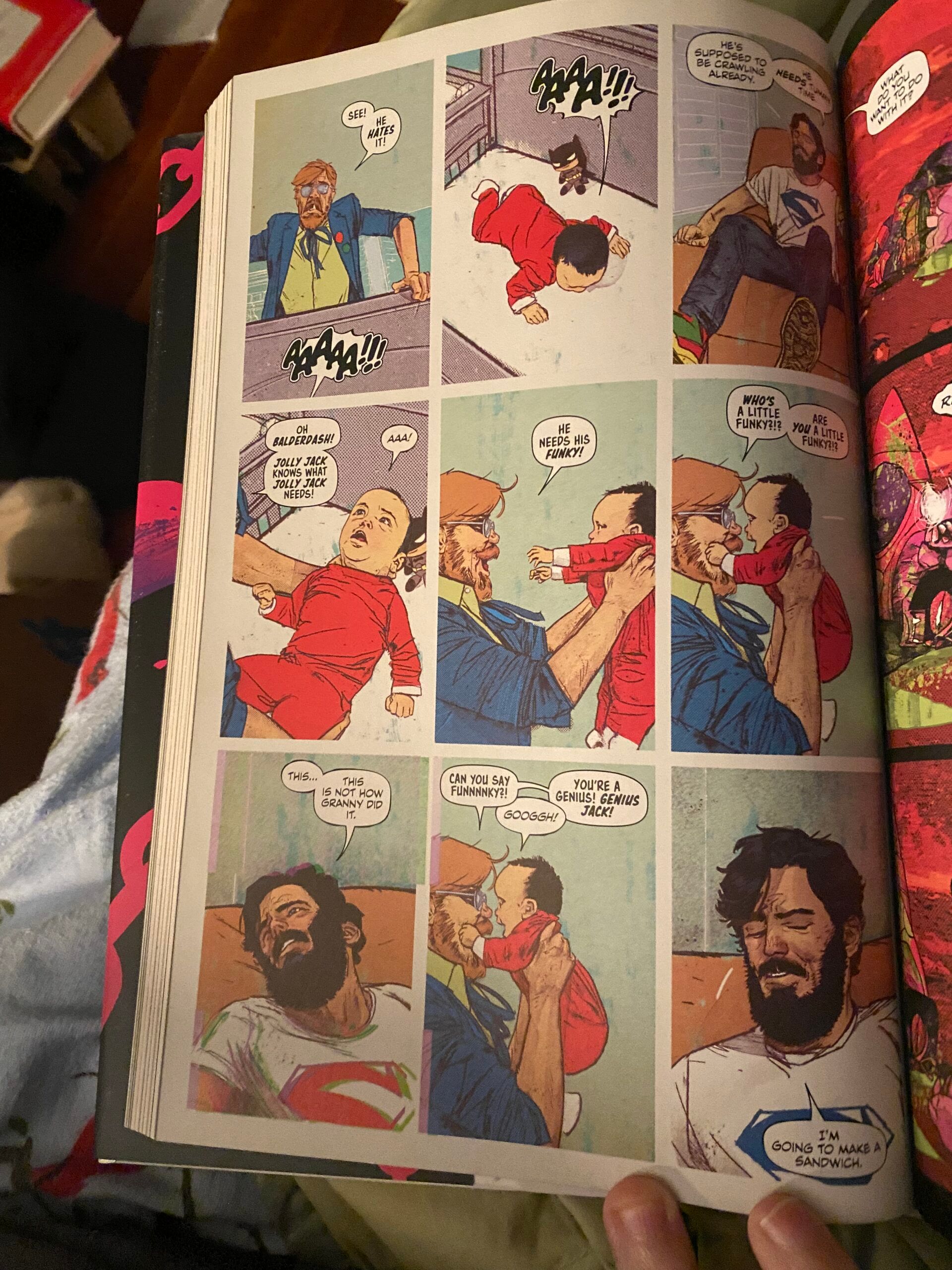
Unfortunately, I care about DC comics a lot, especially superheroes no one has heard of. I care about the name-brand superheroes, too, but my favorite super-teams and stories are solidly d-list, which means I am the precise audience for Tom King’s 2017 run on Mister Miracle.
Mister Miracle is a character in Jack Kirby’s Fourth World saga, which you might have heard of as Jack Kirby’s New Gods or Jack Kirby’s Forever People. Chances are, if you are familiar with these characters at all, it’s through Superman shows or movies. Essentially: dissatisfied with the corporate state of Marvel and on the outs with perpetual self-salesman Stan Lee, Kirby departed Marvel for DC for a few years in the 70’s and got really weird with it. Two gods—- the good Highfather and the evil Darkseid—- have been engaged in war since time immemorial. Highfather rules New Genesis, where all of the new gods live in a great floating city called Supertown. Darkseid rules Apokalips, which is a Warhammer 40k setting.
Darkseid is not evil the way some people are picky eaters; evil is not a character trait. Darkseid is evil, because he is a god of perfect dominance. Darkseid is driven to find the anti-life equation, which is a sort of mathematical proof of the futility of existence. Exposure to it essentially overrides free will; Darkseid seeks it as a tool of dominance.
In an attempt to build a lasting truce, Highfather and Darkseid exchange infant sons. Highfather’s son, Scott Free, grows up in Darkseid’s domain, Apokalips, and is subject to constant terror and abuse until he escapes to Earth, adopts the mantle of Mister Miracle, and becomes a stage magician and superhero in addition to a space god.
Tom King places his run in the then-present day. Mister Miracle (2017-2019) is a self contained story, with a beginning and end, something not super-common in American cape books. Highfather dies, and Scott Free finally inherits his father’s throne. Recovering from his own suicide attempt and juggling the birth of his first child, the war with Apokalips— with Darkseid— goes hot once again.
The book is dated, in kind of a strange way. To my memory, 2017-2019 (that is, the first Trump administration) was a time full of art in which people tried to reckon with getting here. How did America elect Donald Trump to the presidency? How did we do this? How could we do this?
Mister Miracle is interested in these questions; Scott Free, as general of a war, is haunted by the magnitude of responsibility. How many people should die for the cause of defeating his adoptive father? When offered the same bargain to end the war that Highfather was given— custody of his newborn son to ensure a truce— Scott Free is overwhelmed by the burden of the choice. What are you willing to pay for peace? And how do you build a life in the shadow of that choice?

The first issue of the series has this way of imagining omnipresent dread. Scott Free survives his suicide attempt and he is brought back into the world of the living and his wrists bandaged, but he cannot stop remembering that Darkseid is.
God. Do you ever just…remember the president?
I have a terrific fear of the dark. Some of the time, the lights being off in the house is fine, but most days, I need the light on in the hall or on the stairs to successfully navigate it. There’s a way people talk about how horses behave, where sometimes, some animal madness will come over them and they will do things like run full force into brick walls. This is what the dark is like, for me. Sometimes, I can wrest control over the fear by closing my eyes. Art about suicide— about wanting to do it, about living through it, about being left behind by it— feels like closing my eyes in a dark stairwell, and trusting my hand on the rail. I was deeply moved by King’s work.
And then I learned Tom King was in the CIA.
I don’t know what Tom King did in his capacity as a CIA officer. I know that he had been working at Marvel when 9/11 happened, and it motivated him to join the CIA, where he worked for seven years as a counter-terrorism officer.
9/11 made the comics industry insane— this makes sense. The mainstream American comics industry still revolves around New York. Frank Miller tried to run a story where Batman killed Osama Bin Laden— DC refused, but Godzilla localizers Legendary Entertainment later let him file the bat ears off and publish the graphic novel in 2011. Doctor Doom stood at the hole in the Earth that had been the World Trade Center and cried. Comics were hysterical in the aftermath of 9/11, but so was New York and so was the rest of America. The entire apparatus of the media fixated on the disaster, rendered it omnipresent into every American home. News coverage, television shows, public service announcements, advertisements, bumper stickers, channel interstitials, Disney Channel Original Movies, regular movies, restaurant menus, comic books— the September eleventh attacks were transmuted into the terrible, consuming wound that we now call 9/11. Americans briefly experienced weather forecasts which included terror forecasts.
In hindsight, Americans can recognize that this behavior was hysterical; in hindsight, no one wants anyone to be guilty.
For my entire life, the American military has been a volunteer force, which is to say, everyone there decided to be there. America is an unequal society, a violent society, a society that does not start everyone at the same place. As payment for the unique privation and constant surveillance of being a soldier, some of the only socialism practiced in America is exclusive to soldiers and some of their family. Soldiers have access to uniquely subsidized housing and groceries and healthcare and even education. For many people, including some of the anti-war left, the position on The Troops has been that lots of eighteen year olds make terrible decisions, even without these motivations. What about people who are older than that— what if you’re out of college and can even drink?
What if you don’t join the army— what if you join the CIA?
Here’s a fun fact about me: the NSA tried to recruit me. There are a bunch of NSA programs, and when I was in high school, one of them was STARTALK, which was a critical language program that provided grants for education programs. One of these programs was, essentially, a critical strategic languages camp, which set up programs at a few different college campuses to teach high schoolers and college students Mandarin Chinese, Turkish, Farsi, and few other languages. The University of Mississippi (Ole Miss) hosted one of these programs. One summer in high school, I went to NSA funded Chinese camp, and attended a couple of group recruitment sessions with a guy who told us all about the exciting, lucrative opportunities with the NSA we could look into if we kept up with Chinese, or better yet, attended Ole Miss and leveraged their contacts with the agency.
We made a lot (a lot) of jokes about me becoming a spy, and then I took out student loans to go to college because I didn’t want to be a soldier and I did not want to be a spy. I stand by this decision, even if it has sometimes made my life harder. The decision itself was not terribly hard, and to be clear, I do not regret making it at all. Would I have made the same decision if I was 18 when 9/11 happened instead of seven?
The CIA, or Central Intelligence Agency, is responsible for such an unending clowncar of 20th century atrocity that the wreckage has its own Wikipedia page, but to me, the CIA will always be “the extraordinary rendition guys.”

“Extraordinary rendition” is a US government term of art. Legally, “rendition” refers to the transfer of custody of a human person; “extraordinary rendition” is the transfer of custody in “extraordinary” circumstances, then. Plainly, extraordinary rendition is when the CIA kidnaps someone and transfers them from a country where torture is illegal to one where torture is legal, or, transferring a person to the Guantanamo Bay Detention Facility, where people are tortured.
Because the CIA is a civilian organization (that is, not a military organization), the flights utilized for extraordinary rendition are not military flights, but instead are chartered from civilian aircraft and civilian organizations. Trevor Paglen and A.C. Thompson’s short, excellent book Torture Taxi discusses how the extraordinary rendition program, and some of its operations, became visible in part because civilian aircraft manifests and movements are public information by law. We know what extraordinary rendition is, in part, because of guys who like to park in fields and watch planes.
The extraordinary rendition program has been expanded enormously, and its strategies are now being used by United States Immigration Customs Enforcement (ICE) to kidnap and disappear immigrants in the United States. Some people on these flights are sent to their country of origin. Some people on these flights are sent to countries they have never been before. Some people on these flights are sent to concentration camps.
My problem with Tom King’s Mister Miracle is that it is not a book about, like, having problems with paying your taxes, knowing what they are used for; it’s not a book about Having To Remember The President. Mister Miracle is a book written by a former CIA officer about the guilt of how we got here.
There’s a posture I have observed in guilty people who want to feel better: their specific actions get abstracted as the actions of everyone, of a rhetorical ‘we.’ Everyone runs red lights, we should all call our mothers more, we all leave our cars idling at the grocery store, everyone is complicit in the Iraq war. The problem I have with this posture is that I made the conscious choice not to work for the US security state. The problem with this posture of collective guilt is that it insists that there is not room in your life to express moral agency; you are simply a victim of narrative and circumstance.
I believe this is fundamentally wrong. You are a moral agent in your life. You can— and do!— make choices that matter, moral choices, ethical choices.
Many people attempt to end-run the problem of works having creators by invoking “the death of the author.” To be blunt, this was not what Roland Barthes was fucking talking about when he wrote the essay La morte de l’auteur in 1967. The purpose of Barthes’ essay was to divorce the work of biography from the work of criticism; to let the work stand on its own, instead of in the shadow of its maker. Barthes’ essay is a commentary on directing interpretation and critique. To insist that a work is fine to engage with because “the author is dead” is not a gesture that opens criticism, but instead a conflation of the active engagement of criticism with strategic disengagement. The author being dead would mean that it does not matter to the interpretation of the book; the interpretation of the book does not matter to me because I object, as a matter of personal ethics, to its inclusion in culture at all.
Culture is a shared work. It isn’t precisely directed from the top down, nor is it grown from the bottom up. It’s a big, weird net that stretches in every direction, connected to and connecting everything and everyone. You are made by culture— it dictates the language you speak, the food on your table, the cut of the clothes you wear— but you personally also make culture. You can decide how relevant something is, if at all, by engaging with it or not engaging with it. If you don’t like the pants, you don’t have to wear them. If you don’t like the movie, you don’t have to watch it. If you ethically object to the actions of a specific creator, or the conditions under which a work was made, you do not have to engage with that work. You are a moral agent in your own life. You can make moral decisions.
I played a tremendous amount of Fortnite from 2020 to 2024. I will never play it again; their next major event is Harry Potter themed. Fifty percent of my roommates as an adult have been trans; many of my dearest friends are trans. JK Rowling has decided she will be the personal Hitler of trans people everywhere. I know that legitimating the presence of Harry Potter in culture is the equivalent of shaking the hand of a guy in a white hood. I am a moral agent in my life.
Microsoft is an active player in the ongoing genocide of the Palestinian people. Microsoft provides technology to the Israeli government that is used to extensively surveil and harm Palestinian people (People Make Games has a great video on this, with additional informaiton about the boycott). Continuing to play games published by Microsoft, continuing to use Xbox as a platform, legitimates Microsoft’s participation in that genocide. I am a moral agent in my life.
You do not have to let people who feel guilty launder their bad feelings by including you in a rhetorical we. I have not written this in the hope of convincing you to boycott Fortnite or Microsoft—- although it would kick ass if you did!—- I have written this because I think it is important and beautiful to remember that the choices you make and the life you lead matters. I have written this because I see the logic of the anti-life equation fly through our discourse all the time. The rhetorical we not only provides cover for people who regret their actions, it retroactively erases the significance of making different choices. Your choices aren’t futile, no matter how easy or difficult or consequential or inconsequential they are. In short: you matter.


